
Business Plan Template
A business plan doesn’t need to start as a 40-page document. This template walks you through the questions every plan must answer, one short box at a time, and turns your answers into a clean one-page plan. Enter your start-up costs, price, unit costs and monthly fixed costs, and it also calculates your break-even point and a simple 12-month cash projection.
- Free to use
- No sign-up
- Runs in your browser
One-page business plan builder
Numbers
Business Plan Template Pack
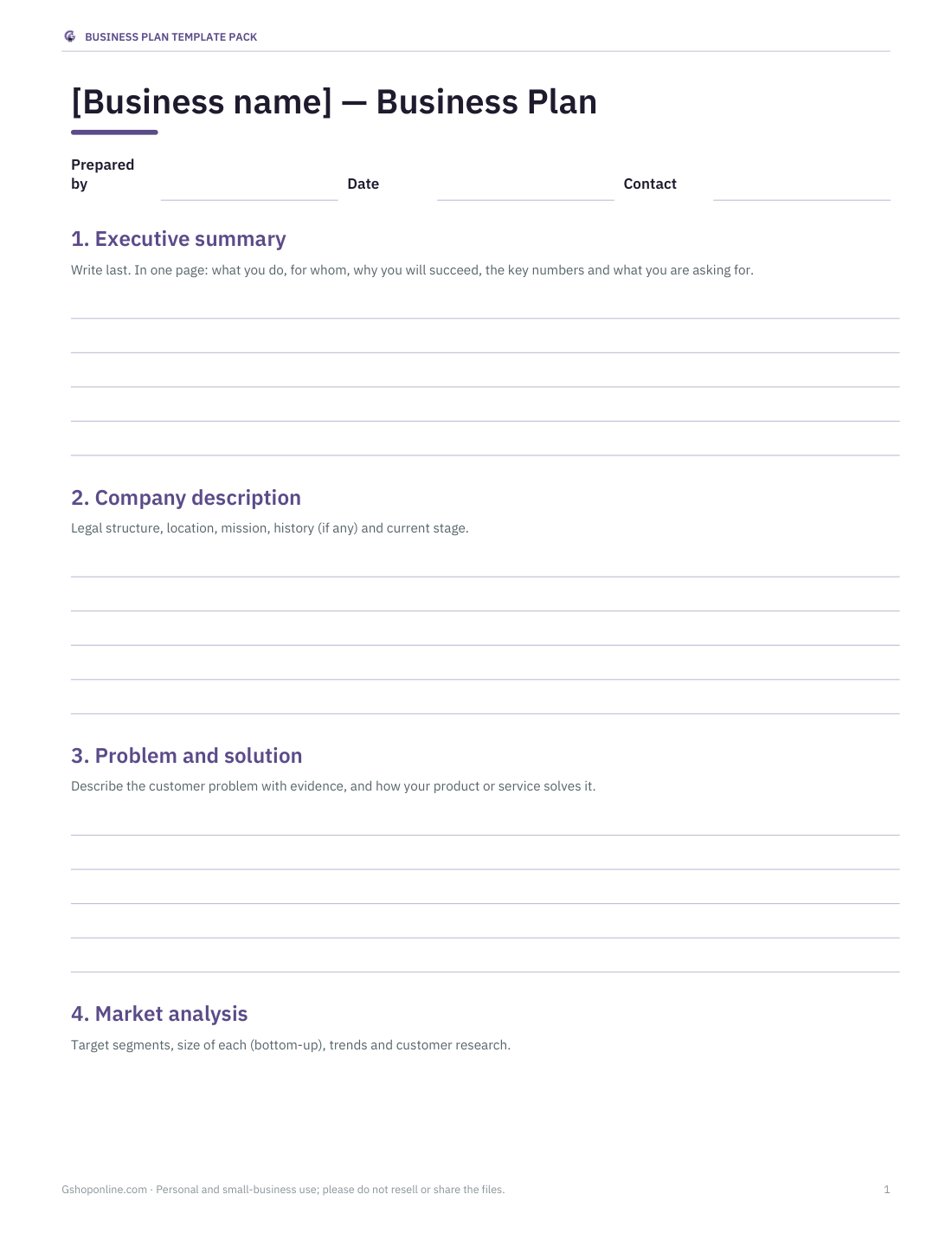
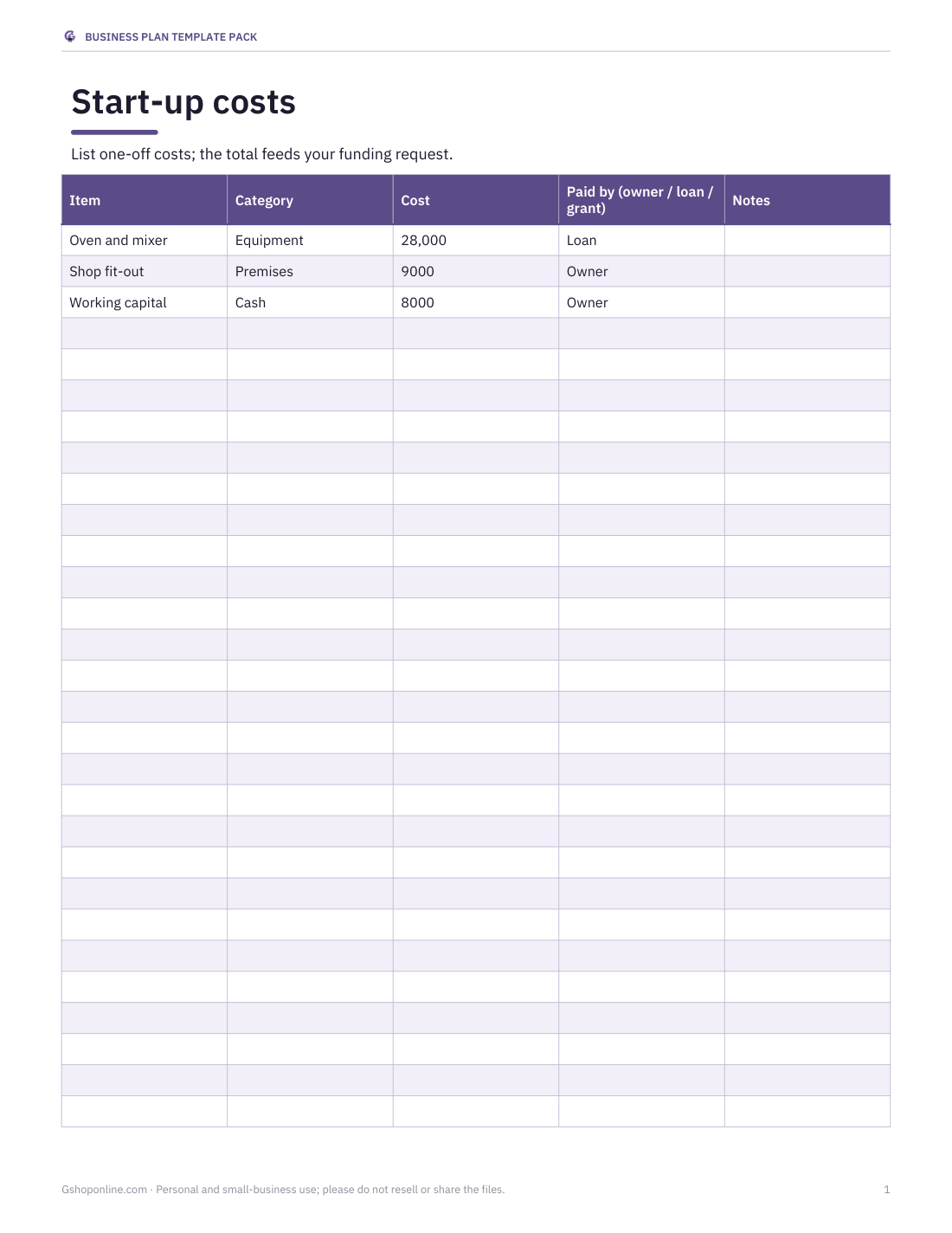
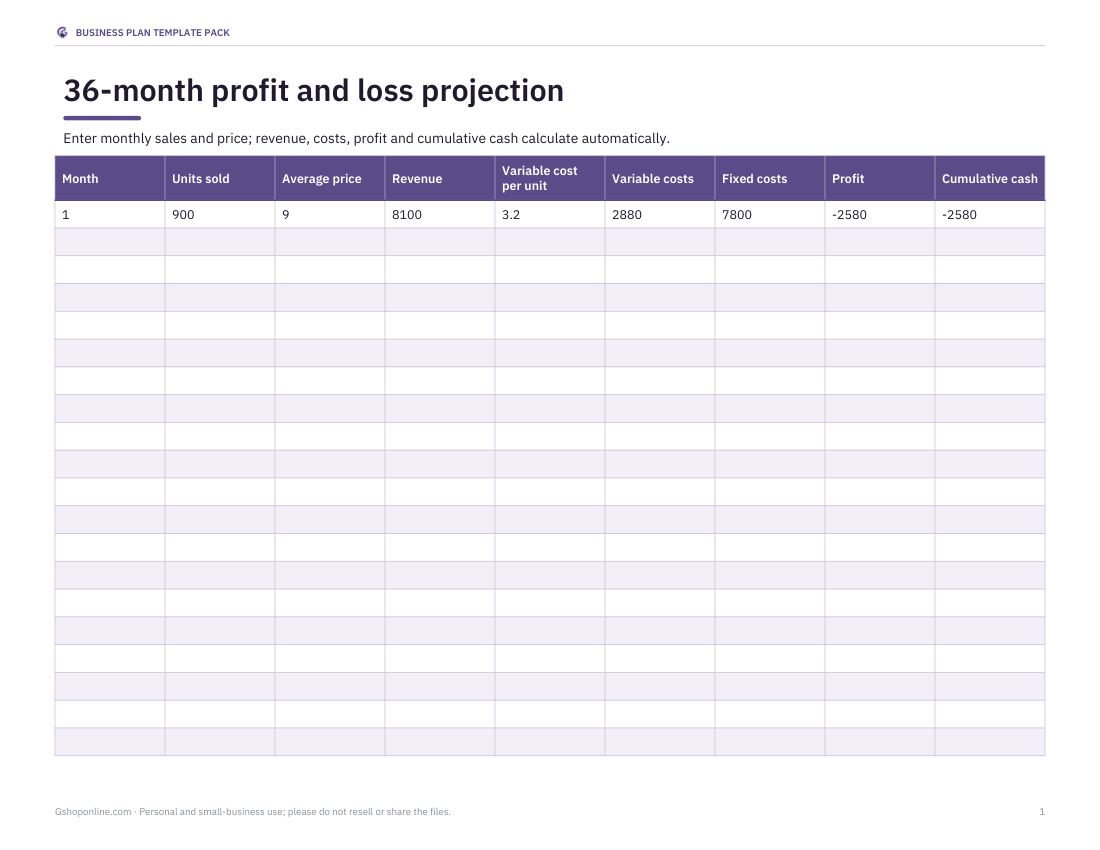
Business plan template pack: full Word business plan template with section prompts, Excel financial model (start-up costs, 36-month P&L, break-even and cash flow), one-page plan, lean canvas, pitch outline and a plan review checklist.
- Business plan template (DOCX/PDF)
- Start-up costs (XLSX)
- Profit & loss projection (XLSX)
- Break-even (XLSX)
- One-page plan (PDF/DOCX)
- Lean canvas (PDF)
- Pitch outline (DOCX)
- Review checklist (PDF, DOCX)
Formats: DOCX, PDF, XLSX. Instant download after payment (link valid 72 hours, up to 5 downloads). AI-assisted: the templates were drafted with AI help and reviewed and laid out before publishing.
$9.00 USD, one-time 8 files · about $1.13 each
- Instant download
- 7-day refund
- Secure checkout by Stripe
7-day money-back guarantee. Full refund within 7 days of purchase, even after you download.
Free sample: Business Plan Template (PDF, 59 KB)
Full refund within 7 days — see the refund policy and license.
Free printables
Single sheets you can print right now, no sign-up. The full pack adds every sheet in one download plus the editable files.
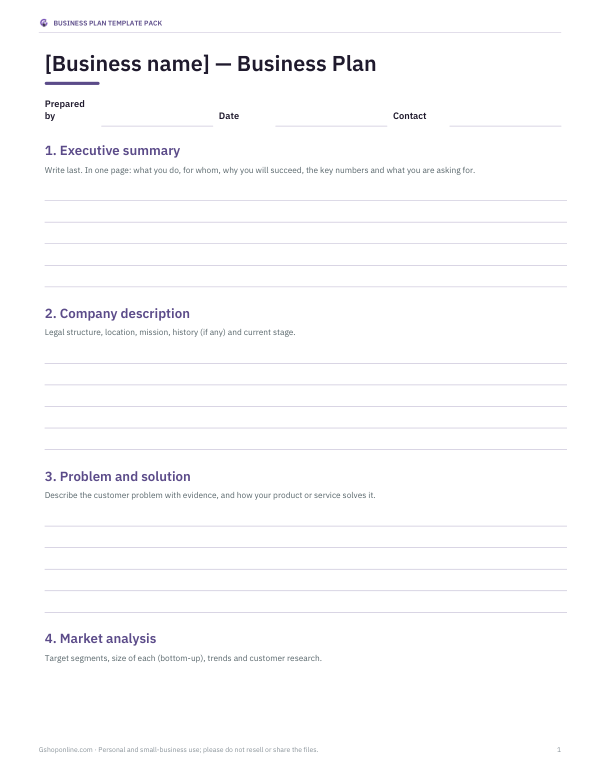 Printable Business Plan Template4 pages · free PDF
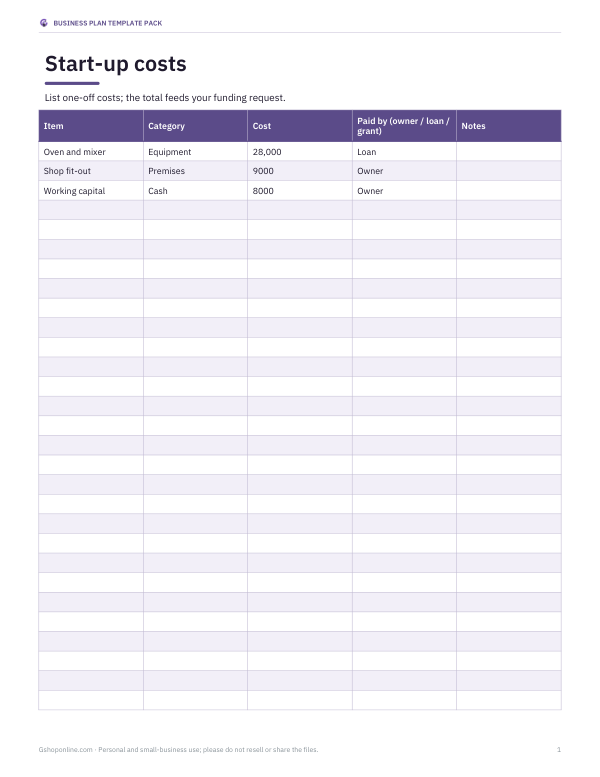 Startup Costs Worksheet2 pages · free PDF
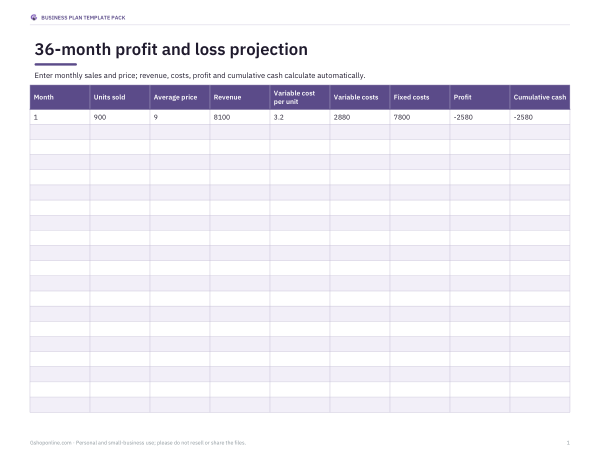 36-Month Profit and Loss Projection2 pages · free PDF
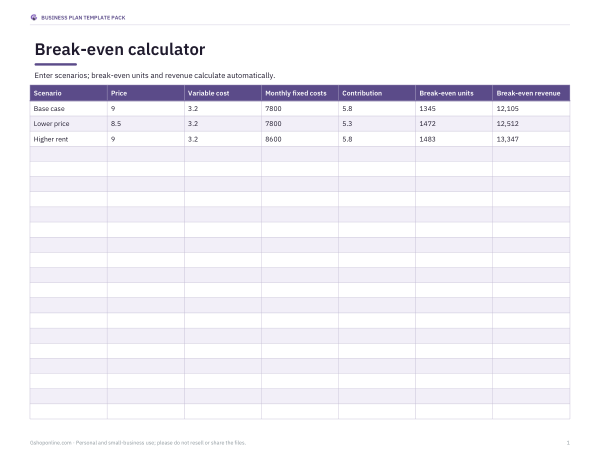 Break-even Calculator Worksheet1 page · free PDF
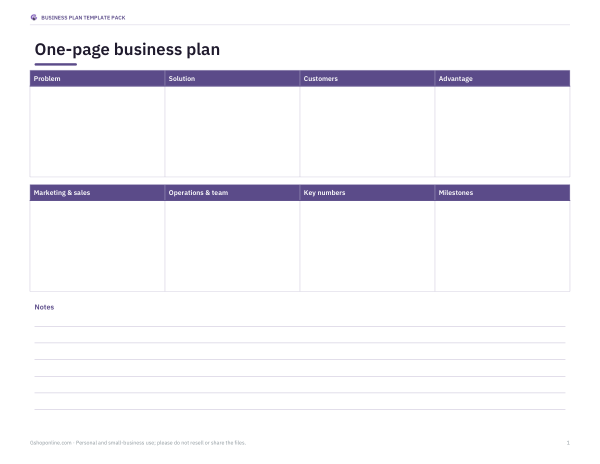 Printable One-Page Business Plan Template1 page · free PDF
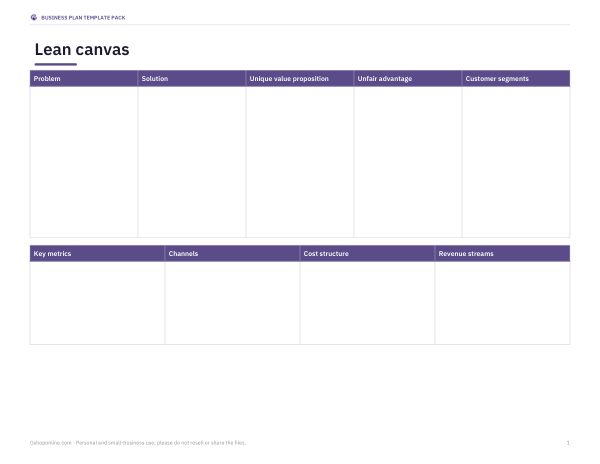 Printable Lean Canvas Worksheet1 page · free PDF
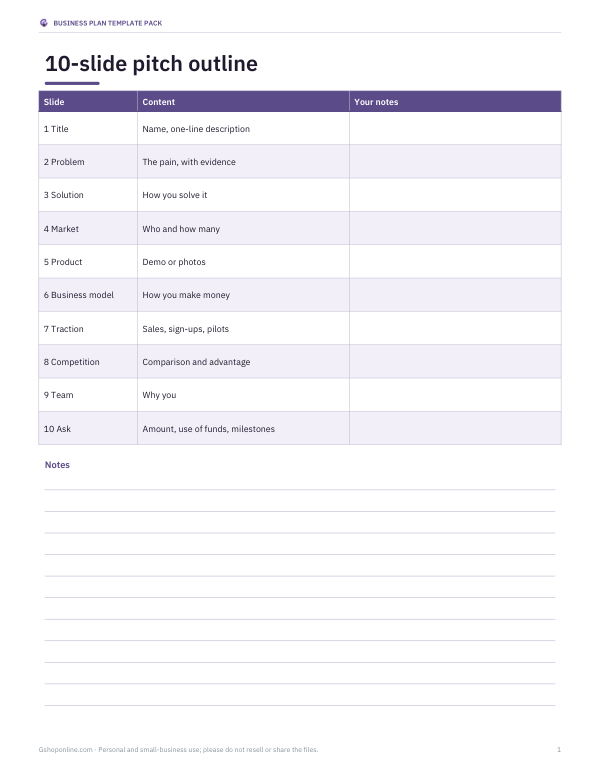 Printable Pitch Outline1 page · free PDF
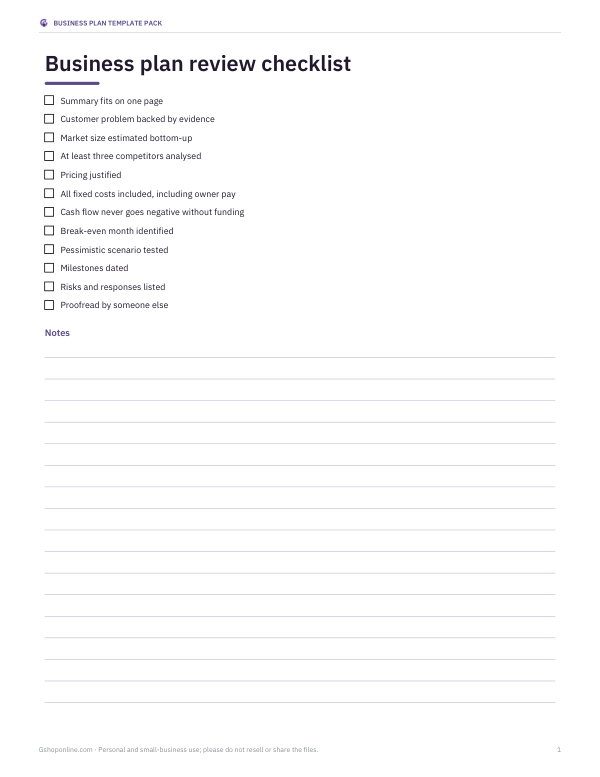 Business Plan Review Checklist1 page · free PDF
What a business plan must answer
| Section | The question it answers |
|---|---|
| Executive summary | What is the business and why will it succeed? (written last) |
| Problem and solution | What need exists and how do you meet it? |
| Market and customers | Who buys, how many of them are there and why would they choose you? |
| Competition | Who else meets the need and what is your advantage? |
| Marketing and sales | How will customers find you and buy? |
| Operations | Where, how and when will you deliver? |
| Team | Who runs it and what experience do they bring? |
| Financials | What will it cost, when will it break even and how much funding is needed? |
| Milestones and risks | What happens when, and what could go wrong? |
Start with one page
A one-page plan forces clarity. If you cannot explain the problem, customer, advantage and numbers in a sentence or two each, a longer plan will only hide the gaps. Many founders write the one-page version first, test it with mentors or potential customers, and expand it into a full plan only when they need one — for a bank loan, investors, a grant or a lease application. The builder above gives you that first page; the downloadable pack has the full template for the next step.
Understanding the numbers
- Contribution margin = average sale − variable cost per sale. It is what each sale contributes towards fixed costs.
- Break-even sales = monthly fixed costs ÷ contribution margin, rounded up.
- Cash projection starts with your cash minus start-up costs, then adds each month’s profit or loss.
- Lowest cash balance shows how much buffer you need; if it goes negative, you need more funding or a slower plan.
Worked example
The sample bakery sells an average of $9 per customer with $3.20 of ingredients and packaging, so each sale contributes $5.80. With $7,600 of fixed monthly costs (rent, wages, utilities, loan repayment), it breaks even at 1,311 sales a month. Starting at 900 sales and growing 8% a month, it reaches break-even in month 6. After $37,000 of equipment and fit-out, $8,000 of the $45,000 funding is left as working capital; the early losses draw it down to about $620 in month 5 before it recovers. That is only just enough — a slower start would need more working capital, which is exactly what a projection is for.
Tips for realistic assumptions
- Base sales on evidence: footfall counts, competitor visits, pre-orders or a pilot.
- Include every fixed cost: insurance, software, accounting, loan repayments and your own pay.
- Allow for seasonality — many businesses have slow months.
- Test a pessimistic case: lower sales, slower growth, higher costs.
- Keep a cash buffer of at least three months of fixed costs.
- Update the plan with real figures every month once you open.
Who reads a business plan
| Reader | What they look for |
|---|---|
| Bank or lender | Ability to repay: cash flow, security, owner’s contribution |
| Investor | Market size, growth potential, team, return |
| Landlord | Credible business that can pay the rent |
| Grant body | Fit with the grant’s aims and measurable outcomes |
| You and your team | Clear priorities and targets to steer by |
What is in the template pack
The paid pack contains a full business plan template in Word with guidance prompts for every section, an Excel financial model with start-up costs, a 36-month profit and loss projection, break-even and cash flow sheets linked by formulas, a printable one-page plan, a lean canvas, a pitch outline and a plan review checklist. It is designed for small businesses, side projects and first-time founders.
Common mistakes to avoid
- Writing about the product but not the customer.
- Claiming “no competition” — every need is met somehow already.
- Top-down market sizing (“1% of a huge market”) instead of bottom-up sales estimates.
- Forgetting the owner’s salary or tax.
- Plans that are never revisited after funding is secured.
Privacy and disclaimer
The builder runs entirely in your browser; nothing you type is uploaded or stored. The calculations are simplified planning estimates and not financial, tax or legal advice — check important decisions with an accountant or adviser.
Frequently asked questions
What should a business plan include?
Summary, problem and solution, market, competition, marketing, operations, team, financials, milestones and risks.
How long should a business plan be?
Start with one page; a full plan for lenders or investors is often 15–30 pages.
How do I calculate break-even?
Divide monthly fixed costs by the contribution margin per sale (price minus variable cost).
Is the builder free?
Yes. The downloadable Word and Excel template pack is optional.
How often should I update my business plan?
Review the numbers monthly once trading and refresh the whole plan at least once a year or before seeking funding.
Do I need a business plan for a small side business?
A one-page plan is usually enough to test the idea and your numbers.
What is a good cash buffer?
Many advisers suggest at least three months of fixed costs.
Does the tool save my plan?
No, print it or copy the text before closing the page.
Was AI used to create the templates?
The templates and guidance were drafted with AI assistance and reviewed before publishing.